
Complete Medical Payment Posting Guide for Healthcare Administrators
On this page
Medical Payment Posting gives healthcare administrators a clear record of payments, adjustments, denials, and remaining balances. Accurate posting helps finance and billing teams reconcile deposits, identify unpaid or underpaid claims, and keep accounts current after insurers process claims.
Uncoordinated posting processes delay deposit reconciliation and create revenue-cycle gaps. Payment data discrepancies can also expose unresolved provider or payer record issues that require administrative review.
Medical Payment Posting through BillingXChange supports healthcare administrators with accurate provider, payer, patient, and transaction information. Connecting EOB, ERA, and EFT records through structured workflows ensures complete payment reconciliation and improves overall revenue-cycle control.
What Is Payment Posting in Medical Billing?
Medical Payment Posting is the systematic entry of payments, adjustments, and claim financial details into a practice management system. The process connects billed services directly to actual reimbursement, creating an accurate financial record for healthcare administrators.
- Systematic payment, adjustment, claim detail entry
- Matching transactions to correct patient accounts
- Integrating posting with claim review workflows
- Directing accounts receivable follow-up queues
- Defining staff roles for remittance processing
- Managing exception verification, unresolved balances
Establishing a disciplined workflow highlights the Importance of Payment Posting in Medical Billing by showing how every transaction affects final account balances, preventing unnecessary follow-up tasks.
What Data Does Medical Payment Posting Require?
Accurate Medical Payment Posting relies on complete remittance data, clear validation rules, and precise transaction identification.
1. Essential Data Identification
- Identify patient, claim, service date, billed, allowed, and payment amounts.
- Record adjustment codes and remaining responsibility before closing transactions.
2. Remittance Exception Handling
- Track denial indicators, remark codes, refunds, take-backs, and secondary details.
- Prevent reconciliation errors to keep accounts from entering incorrect statuses.
3. Workflow Validation Rules
- Establish consistent validation rules before posting to eliminate duplicate entries.
- Maintain separate transaction rules across medical and Dental Billing operations.
Reviewing Medical Payment Posting Need to Know About helps administrators maintain accurate account balances, eliminate misapplied payments, and improve overall revenue control.
Key Data Elements in Medical Payment Posting
| Data Element | Why It Matters |
| Patient account number | Links to the patient record |
| Claim number | Tracks the submitted claim |
| Service date | Confirms the encounter |
| CPT/HCPCS codes | Identifies billed services |
| Billed and allowed amounts | Compares charges and payment |
| Payment amount | Records funds received |
| Adjustment codes | Explains payment reductions |
| Patient responsibility | Shows amounts owed by patient |
| EFT, check, or trace number | Supports payment matching |
How Does Medical Payment Posting Affect Revenue?
Proper Medical Payment Posting directly impacts revenue visibility by reflecting real-time transaction changes across patient accounts.
1. Financial Visibility Improvement
- Update patient account balances promptly.
- Identify unresolved claims and underpayments.
- Measure collection performance with confidence.
- Monitor payer performance using Medical Billing workflows.
2. Operational Account Control
- Eliminate unnecessary follow-up on paid claims.
- Prevent duplicate work caused by delayed posting.
- Align accounts receivable reports with payment activity.
- Strengthen operational planning across practice teams.
3. Financial Record Management
- Separate unpaid balances from resolved claims using Medical Payment Posting.
- Connect cash received directly to reported revenue activity.
- Reduce the risk of sending inaccurate balances to patients.
- Maintain clear accounts receivable reports with timely posting.
4. Operational Revenue Optimization
- Identify claims requiring additional action using denial information.
- Spot reimbursement trends by payer, service line.
- Track unresolved claims to measure collection performance.
- Support accurate cash forecasting, operational planning.
A documented Medical Payment Posting Process and Practices framework can also help teams standardize reconciliation and exception handling.
How Does Medical Payment Posting Handle EOB, ERA, and EFT?
Executing Medical Payment Posting requires precise reconciliation across multiple payment formats to maintain accurate patient financial records.
Remittance Format Reconciliation
- EOB Processing: Review claim payment and responsibility details.
- ERA Delivery: Process electronic remittance information efficiently.
- EFT Matching: Reconcile electronic fund transfers with bank deposits.
Transaction Detail Verification
- Data Review: Check adjustment codes, payer responsibility, patient responsibility.
- Claim Tracking: Match remittance records directly to patient accounts.
- Process Alignment: Apply standard reconciliation across Dental Billing operations.
Exception Queue Management
- Mismatch Identification: Isolate discrepancies between EFT funds, remittance files.
- Accuracy Protection: Route unaligned transactions into exception queues.
- Audit Control: Maintain clear audit trails across all service lines.
Understanding the Importance of Payment Posting in Medical Billing ensures complete financial accuracy when EOB, ERA, and EFT records do not align.
EOB, ERA, and EFT Comparison
| EOB (Explanation of Benefits) | ERA (Electronic Remittance Advice) | EFT (Electronic Funds Transfer) |
| Paper statement | Digital 835 file | Direct bank deposit |
| Manual breakdown | Automated data | Direct fund transfer |
| Billed, allowed amounts | Adjustment, denial codes | Deposit, trace number |
| Slow mail delivery | Fast digital processing | Direct bank availability |
| Requires manual posting | Enables auto-posting | Reconciles bank balance |
| Higher error risk | Lower error risk | Secure digital transfer |
| Manual exception review | Automated exception queue | Deposit matching queue |
| Physical audit copy | System integration | Revenue reconciliation |
What Are the Benefits of Medical Payment Posting for Healthcare Administrators?
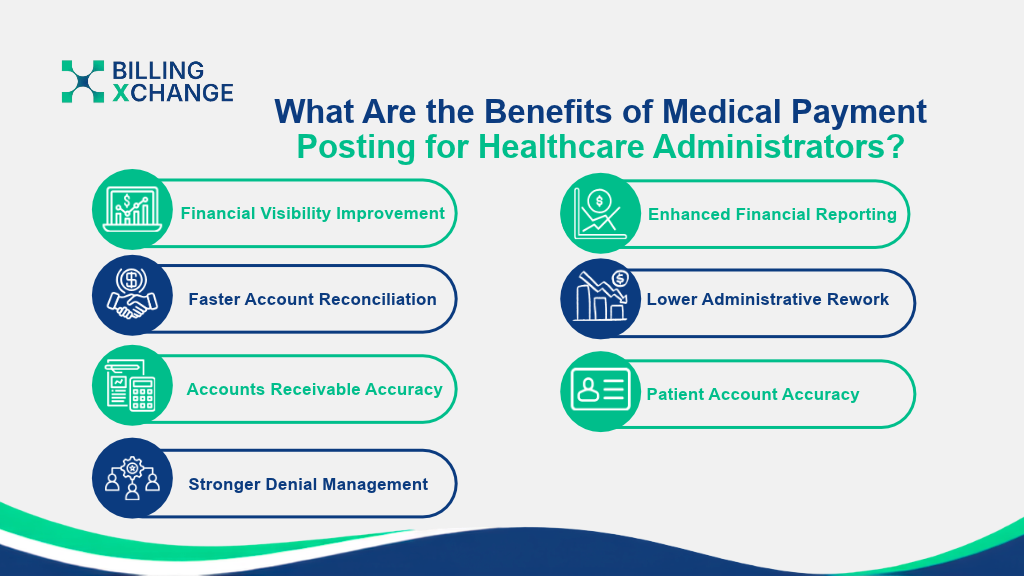
Medical Payment Posting gives administrators cleaner financial data and a stronger basis for operational decisions. The process helps translate remittance activity into usable account information that billing, finance, and management teams can review.
1. Financial Visibility Improvement
- Clear Tracking: View total amounts paid, adjusted, transferred, or left outstanding.
- Data Control: Translate remittance activity into usable financial management information.
2. Faster Account Reconciliation
- Bank Alignment: Compare bank activity directly with remittance records.
- Account Verification: Reconcile patient accounts systematically through routine posting workflows.
3. Accounts Receivable Accuracy
- Balance Correction: Reduce false balances through correct transaction allocation.
- Report Reliability: Improve aging report precision across billing operations.
4. Stronger Denial Management
- Pattern Identification: Analyze adjustment details to uncover recurring claim issues.
- Process Correction: Implement necessary claim corrections based on denial trends.
5. Enhanced Financial Reporting
- Transaction Consistency: Support payer analysis through unified billing data.
- Collection Tracking: Streamline month-end reporting across revenue management teams.
6. Lower Administrative Rework
- Search Reduction: Eliminate repetitive manual account reviews using clear workflows.
- Efficiency Gains: Standardize daily tasks to prevent unnecessary staff follow-up.
7. Patient Account Accuracy
- Statement Protection: Prevent patient statements from reflecting incorrect balances.
- Current Allocation: Post accurate payment amounts to maintain balance integrity.
A documented Medical Payment Posting Process and Practices framework can also help teams standardize controls, reconciliation, and exception handling.
Why Choose BillingXChange for Medical Payment Posting?
Medical Payment Posting reduces administrative workload for healthcare organizations through structured operational support. Administrators evaluate core operational factors, including payment entry, adjustments, reconciliation, exception handling, and detailed reporting.
Integration begins by connecting posting tasks with broader billing operations to provide a unified view of claims, adjustments, and accounts receivable. A coordinated workflow standardizes financial processes across service lines while resolving complex exceptions.
BillingXChange provides clear turnaround expectations, organized transaction tracking, and escalation paths for unresolved transactions. Our service model tracks posting accuracy and turnaround time, helping teams focus on growth and core operations.
Conclusion
Medical Payment Posting is a core financial workflow affecting account accuracy, revenue visibility, reconciliation, and follow-up. Prompt posting and careful remittance matching ensure administrators gain clear insight into overall financial performance and outstanding work.
A strong process relies on data validation, EOB, ERA, EFT reconciliation, adjustment handling, exception management, and reporting. Defining clear workflow ownership prevents unresolved transactions from lingering in the system without follow-up.
Choose BillingXChange for reliable Medical Payment Posting solutions. Contact us now to build a customized workflow tailored to your payment volume, payer mix, and reporting requirements.
Frequently Asked Questions
1. Why is Medical Payment Posting important for healthcare administrators?
This process helps administrators maintain accurate balances, monitor reimbursement, reconcile deposits, and identify unresolved claim activity.
2. What is the difference between an EOB and an ERA?
An EOB explains claim payment and patient responsibility details, usually in a paper or digital statement. An ERA sends comparable remittance information electronically and can support more efficient posting.
3. How can Medical Payment Posting improve accounts receivable?
Medical Payment Posting applies payments and adjustments to the correct accounts, helping teams distinguish genuine outstanding balances from claims that have already been paid or adjusted.
4. What happens when payment and remittance amounts do not match?
The transaction should move into an exception workflow for review. Teams can verify the EFT, remittance details, claim information, and adjustment codes before finalizing the account.
5. How should administrators measure payment posting performance?
Useful measures include posting accuracy, turnaround time, unmatched payment volume, correction rates, and the number of unresolved exceptions.

BillingXchange team
Written by the BillingXchange team. We help dental and medical practices reduce denials, accelerate payments, and maximize collections through expert revenue cycle management.
Medical Credentialing Company Strategies For Urgent Care Scaling
NextMedical Denial Management Analytics for Healthcare Organizations
Building Trust Through Transparent Medical Accounts Receivable Management Systems
Oct 28, 2026
Boost Practice Revenue Using Medical Claim Submission Services
Oct 27, 2026
Maximizing Practice Profits with Medical Insurance Eligibility Verification
Oct 26, 2026