Maximizing Practice Profits with Medical Insurance Eligibility Verification
On this page
Medical Insurance Eligibility Verification helps healthcare organizations protect practice profitability before claims reach payers. Front-end teams gain early visibility into active coverage, benefit details, payer information, expected patient responsibility, preventing avoidable billing work.
For physician groups, specialty practices, multi-location organizations, healthcare administrators, a standardized workflow reduces repetitive research. Clear processes improve coordination across scheduling, registration, revenue-cycle teams.
Medical Insurance Eligibility Verification through BillingXChange supports practice workflows with standardized structures. Leaders measure clear results through reduced claim rejections, decreased denials, improved collections, higher staff productivity.
What Is the Role of Insurance Eligibility Verification in Medical Billing?
Medical Insurance Eligibility Verification helps healthcare organizations protect practice profitability before claims reach payers. Front-end teams gain early visibility into active coverage, benefit details, payer information, expected patient responsibility, preventing avoidable billing work.
- Standardize workflows across practices, locations, administrative teams.
- Reduce repetitive research across front-office operations.
- Improve coordination across scheduling, registration, revenue-cycle teams.
- Track performance using rejections, denials, collections, staff productivity.
- Protect overall practice profitability prior to claim submission.
Establishing structured Medical Insurance Eligibility Verification Services supports practice workflows with standardized structures, enabling healthcare leaders to measure clear operational results.
How Does Eligibility Verification Improve Practice Profits?
The financial effect of proactive verification depends on error prevention before service delivery. Structured Medical Insurance Eligibility Verification protects revenue streams by resolving coverage issues prior to claim submission.
Proactive Coverage Identification
- Identify inactive coverage prior to service delivery.
- Detect incorrect payer information early.
- Resolve benefit restrictions before treatment.
Patient Cost Communication
- Access deductibles, copayments, coinsurance financial details.
- Strengthen staff ability to communicate expected patient costs.
- Align front-end findings directly with CMS eligibility guidelines.
Operational Labor Allocation
- Establish standard checks, exception queues, escalation rules.
- Eliminate manual research after claim failure occurs.
- Focus staff effort on accounts requiring deeper research.
Financial Performance Measurement
- Measure rejection rates, registration corrections, avoidable denials.
- Track patient balance adjustments, overall collection performance.
- Evaluate labor costs, turnaround time, capacity review metrics.
Following a structured Medical Insurance Eligibility Verification workflow connects front-end verification directly with claim preparation, documentation, follow-up, receivables management to drive practice profitability.
What Are the Types of Medical Insurance Eligibility Verification?
Organizations select verification models based on appointment volume, payer mix, technology, staffing capacity, operational complexity. Understanding models within Medical Insurance Eligibility Verification keeps manual work controlled while providing reliable coverage information.
1. Manual Verification
- Payer Portals: Staff access payer portals or contact representatives directly.
- Coverage Records: Review coverage information, record findings manually.
- Low Volume: Manage lower appointment counts or complex exceptions.
2. Automated Electronic Verification
- Structured Responses: Electronic systems submit requests, return instant coverage data.
- Standardized Inquiries: CMS defines eligibility benefit inquiries as standardized processes.
- Exception Rules: Establish rules for demographic mismatches or service questions.
3. Batch Verification
- Scheduled Groups: Process groups of scheduled patients simultaneously.
- Pre-Appointment Prep: High-volume organizations prepare coverage data prior to visits.
- Workflow Efficiency: Eliminate total reliance on individual manual checks.
4. Outsourced Verification
- Specialized Teams: Manage routine verification, payer research, documentation.
- Exception Handling: Support operations when internal staffing faces capacity limits.
- Performance Evaluation: Compare models by accuracy, turnaround time, total cost.
Comparing models within a Medical Insurance Eligibility Verification framework across medical, Dental Billing operations ensures high accuracy, fast turnaround times, reduced total operational costs.
Insurance Eligibility Verification Types & Key Features
| Types | Key Features |
| Manual Verification | Portal checks, coverage review |
| Automated Verification | Instant responses, standardized data |
| Batch Verification | Bulk checks, scheduled processing |
| Outsourced Verification | Payer research, documentation support |
What Are the Key Benefits of Automated Insurance Eligibility Verification?
Automated Medical Insurance Eligibility Verification creates repeatable front-end processes through defined workflows. Administrators establish standard rules, escalation paths, replacing individual staff reliance.
1. Faster Account Processing
- Handle larger groups of scheduled accounts efficiently.
- Focus staff effort on missing, conflicting, exception-based accounts.
2. Operational Visibility Improvement
- Centralize verification tracking across completed checks, unresolved accounts, workload trends.
- Connect verification findings directly with Medical Billing revenue-cycle activity.
3. Preventable Error Reduction
- Correct coverage, registration errors prior to claim submission.
- Leverage CAQH high-volume administrative transaction efficiency opportunities.
4. Revenue Cycle Coordination
- Apply verification findings toward claim preparation, follow-up, account resolution.
- Eliminate isolated front-end task structures across operational teams.
5. Patient Communication Clarity
- Provide staff stronger bases for explaining expected financial responsibility.
- Reduce patient confusion regarding individual financial obligations.
Evaluating the Importance of Medical Insurance Eligibility Verification reduces rework, improves data quality, maintains operational oversight through defined exception rules.
Insurance Eligibility Verification Benefits & Key Advantage
| Benefit | Key Advantage |
| Faster Account Processing | Handles scheduled accounts efficiently |
| Operational Visibility | Tracks checks, workload, and issues |
| Error Reduction | Corrects coverage and registration errors |
| Revenue Cycle Coordination | Supports claims and account resolution |
| Patient Communication | Clarifies expected financial responsibility |
How to Audit Your Current Eligibility Verification Process?
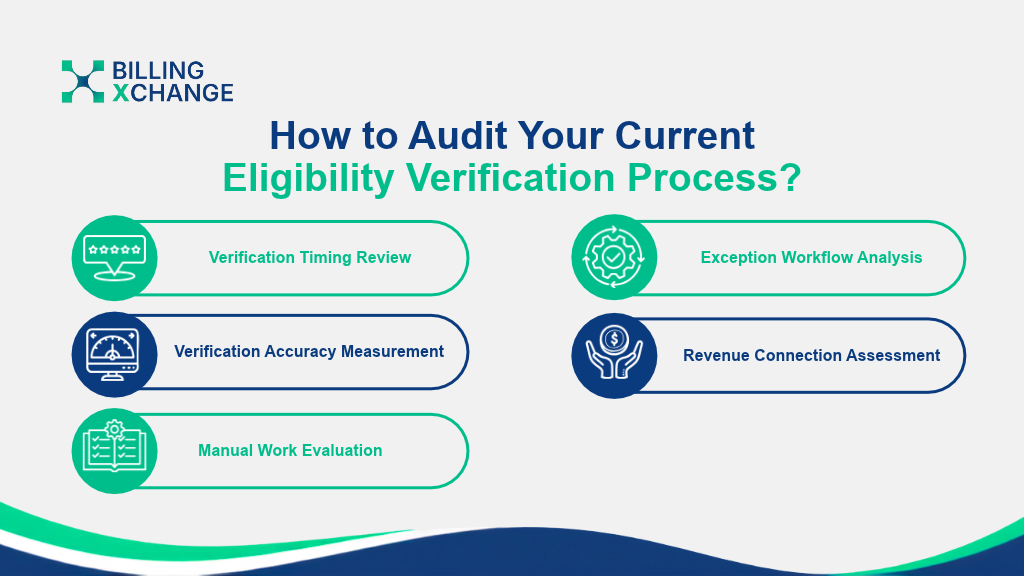
Auditing a Medical Insurance Eligibility Verification workflow determines whether processes produce accurate coverage data early enough for administrative action across scheduling, registration, claim submission.
Step 1: Verification Timing Review
- Timing Alignment: Determine when teams perform initial checks, rechecking accounts when appointments change or coverage appears uncertain.
- Risk Matching: Align verification timing directly with appointment volume, payer complexity, organizational risk.
Step 2: Verification Accuracy Measurement
- Outcome Comparison: Compare verification records against payer responses, downstream claim outcomes.
- Error Identification: Pinpoint incorrect member IDs, inactive coverage, incorrect payer selections, inaccurate patient responsibility data.
Step 3: Manual Work Evaluation
- Task Tracking: Track portal logins, phone calls, spreadsheet updates, manual documentation efforts.
- Automation Opportunity: Highlight workflow gaps, weak system integration, automation opportunities to elevate the Importance of Medical Insurance Eligibility Verification.
Step 4: Exception Workflow Analysis
- Account Categorization: Separate routine accounts from cases requiring specialized human intervention.
- Resource Allocation: Determine whether staff time focuses on standard checks or complex payer scenarios.
Step 5: Revenue Connection Assessment
- Financial Review: Review eligibility-related rejections, denials, payment delays, registration corrections.
- Downstream Impact: Measure how front-end verification quality directly improves downstream financial performance.
Evaluating Outsource Medical Insurance Eligibility Verification as part of a structured cost, capacity, labor review ensures operational decisions focus on measurable service requirements.
Why Choose BillingXChange for Medical Insurance Eligibility Verification?
Medical Insurance Eligibility Verification provides structured workflows without increasing administrative burden. Processes focus on timely coverage checks, clear documentation, exception handling, full visibility into unresolved accounts.
Workflows align with scheduling, registration, revenue-cycle procedures across changing volumes, multiple locations, complex payer mixes. Defined processes ensure consistent record-keeping while routing unusual cases for review.
BillingXChange emphasizes coordination across revenue-cycle functions beyond completing routine checks. Making coverage information useful strengthens registration decisions, patient communication, claim preparation, follow-up activities.
Conclusion
Medical Insurance Eligibility Verification detects coverage, benefit issues before they become billing problems. Structured processes support cleaner front-end operations, accurate patient responsibility estimates, efficient staff workflows, stronger revenue cycle coordination.
An effective process combines standard procedures, automation, quality controls, clear exception management. Leaders assess performance by connecting verification activity directly with rejections, denials, collection outcomes, staff effort.
Protect practice profitability, streamline patient registration. Contact us today with BillingXChange to build an efficient Medical Insurance Eligibility Verification workflow.
Frequently Asked Questions
1. What information is checked during Medical Insurance Eligibility Verification?
Reviews active coverage, member demographics, effective dates, deductibles, copayments, coinsurance, benefit limits.
2. When should eligibility verification be completed?
Complete checks prior to service delivery. Recheck accounts whenever appointment details or coverage status change.
3. Can Medical Insurance Eligibility Verification reduce claim denials?
Yes. Identifies inactive coverage, incorrect payer details, missing benefits prior to submission, reducing preventable rejections.
4. How does automation support eligibility verification?
Submits routine inquiries, flags exceptions, organizes payer responses, reducing repetitive manual administrative tasks.
5. What should organizations measure in Medical Insurance Eligibility Verification?
Track verification accuracy, turnaround speed, exception rates, registration error corrections, staff productivity.

BillingXchange team
Written by the BillingXchange team. We help dental and medical practices reduce denials, accelerate payments, and maximize collections through expert revenue cycle management.