
Building Trust Through Transparent Medical Accounts Receivable Management Systems
On this page
Medical Accounts Receivable Management helps medical practices monitor unpaid claims, patient balances, aging accounts, payment activity. Transparency directly improves collections, staff productivity, patient billing experiences.
Consistent workflows build trust through clear status tracking, documented follow-up, timely communication. Organized processes prevent billing friction while ensuring unresolved accounts receive structured attention.
BillingXChange organizes revenue-cycle operations around visibility, accountability, measurable follow-up. Structured Medical Accounts Receivable Management helps practices maintain financial control and improve collections.
What is AR Management in Medical Billing?
Medical Accounts Receivable Management tracks, prioritizes, resolves money owed to a practice after providing services. Balances originate from insurance claims, patient responsibility, denied claims, underpayments, delayed payments, documentation requests.
- Track service dates, billed amounts, expected reimbursements, received payments, remaining balances.
- Identify specific payer status, denial reasons, next required collection actions.
- Create detailed working views for accounts instead of generalized aging reports.
- Distinguish payer balances from patient balances across separate collection workflows.
- Establish clear communication, documented follow-up procedures for unresolved accounts.
Establishing structured Accounts Receivable Management in Medical Billing supports practice revenue workflows with clear operational controls, enabling healthcare leaders to measure financial performance.
How can Medical Accounts Receivable Management build patient trust?
Structured Medical Accounts Receivable Management builds patient trust by aligning financial communication with actual account statuses, clear statements, accurate payment records.
1. Account Data Transparency
- Document payments accurately following insurance adjustments.
- Explain post-payer patient responsibilities clearly.
- Answer balance questions using specific transaction details.
- Prevent repeated patient explanations across multiple conversations.
2. Patient Experience Simplification
- Provide simple payment options with clear statements.
- Send timely reminders alongside online payment access.
- Establish consistent escalation rules for complex balances.
- Reduce communication confusion during patient collection processes.
3. Documented Team Standards
- Maintain consistent account notes across all internal staff.
- Provide documented guidelines for resolving account questions.
- Explain outstanding amounts using plain language.
- Ensure patient interactions remain respectful, predictable, accurate.
4. Integrated Billing Workflows
- Connect claim activity directly with transparent collection processes.
- Align payment posting with ongoing account follow-up.
- Integrate denial handling to keep statements accurate.
- Strengthen patient confidence through organized revenue management.
A documented Medical Billing A/R Management framework helps medical practices maintain transparent communications while streamlining daily collection operations.
What Financial Benefits Does Medical Accounts Receivable Management Provide?
Structured Medical Accounts Receivable Management supports financial performance by converting unresolved balances into defined work queues. Understanding core workflow benefits keeps follow-up controlled while providing reliable cash-flow tracking.
Work Queue Prioritization
- Balance Priority: Target high-value balances, older claims, repeated denials, payer delays.
- Deadline Tracking: Identify accounts approaching filing or appeal deadlines.
- Queue Structure: Turn unresolved balances into organized daily work queues.
Cash Flow Visibility
- Revenue Tracking: See outstanding revenue amounts sitting across aging cycle stages.
- Actionable Accounts: Identify specific balances requiring immediate operational action.
- Standardized Worklists: Reduce time spent repeatedly reviewing identical account files.
Revenue Loss Protection
- Follow-Up Preservation: Protect revenue otherwise lost through missed follow-up actions.
- Measurable Movement: Connect recovery activities directly with tracked account progress.
- Final Payment Paths: Build reliable paths leading from initial charges to final payment.
Service Line Alignment
- Broad Principles: Apply receivables principles across broader practice revenue workflows.
- Complementary Support: Coordinate dental receivables alongside medical revenue processes.
- Unified Handling: Align payment posting, denial resolution, aging follow-up.
Applying structured principles to Manage Accounts Receivables for Medical Practices creates reliable paths from charges to final payment while protecting overall revenue.
Medical Accounts Receivable Management Benefit & Key Advantage
| Benefit | Key Advantage |
| Work Queue Prioritization | Focuses on high-value and aging claims |
| Cash Flow Visibility | Tracks outstanding revenue and balances |
| Revenue Loss Protection | Prevents missed follow-up and lost revenue |
| Service Line Alignment | Coordinates receivables across workflows |
How can Medical Accounts Receivable Management improve workflow tracking?
Structured Medical Accounts Receivable Management improves workflow tracking by giving every unresolved account a clear status, action item, and follow-up date. It converts informal reminders into a repeatable process.
1. Account Categorization Framework
- Organize accounts based on payer, aging bucket, and balance size.
- Group accounts by denial type, patient responsibility, and required documentation.
- Set daily priorities based on financial impact and urgency.
2. Technology Workflow Integration
- Monitor claim status, payment posting, and aging trends through dashboards.
- Flag actionable accounts through automated reminders.
- Use standardized notes to maintain team continuity.
3. Key Financial Metrics
- Monitor outstanding receivable time through Days in AR.
- Track the growth of older balances through AR aging buckets.
- Compare expected revenue with collected revenue through collection rates.
4. Operational Performance Metrics
- Track claim impact through denial rates and denial values.
- Measure assigned work completion according to the scheduled workflow.
- Monitor account closure progress through patient balance resolution.
5. Dashboard Action Controls
- Link every tracking metric directly to a specific action.
- Assign a clear owner to each account follow-up task.
- Maintain a regular review cadence for continuous tracking.
Implementing effective Medical AR Management provides Medical Billing operations with complete visibility, a connected operating view, and structured tracking support.
What are the Key Steps in Medical Accounts Receivable Management?
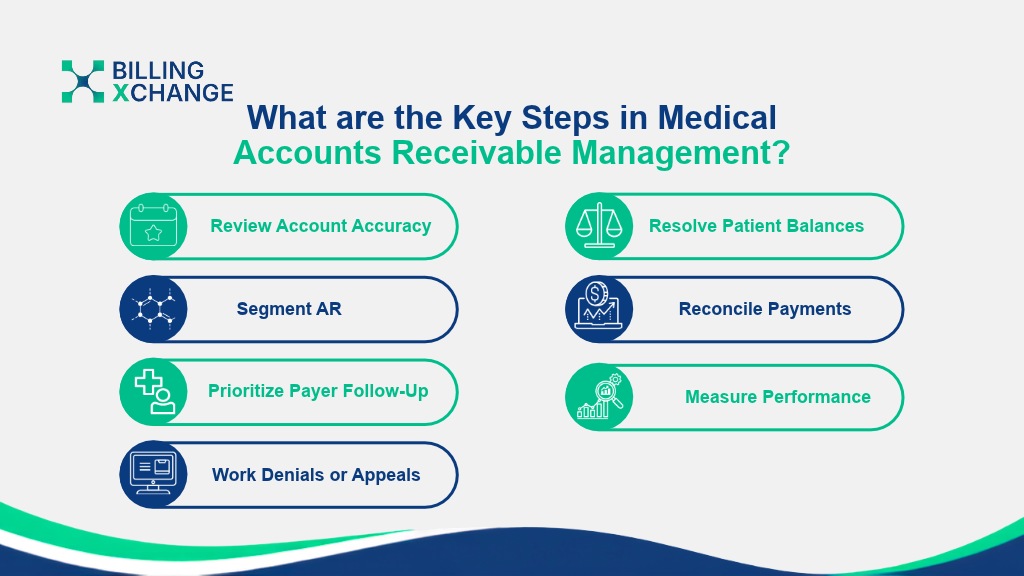
Structured Medical Accounts Receivable Management connects front-end accuracy directly with collection activity, reducing delayed, denied, or unresolved accounts.
1. Review Account Accuracy
- Data Verification: Confirm patient demographics, insurance details, provider info, service dates.
- Claim Auditing: Verify charges, codes, claim status before initiating follow-up.
2. Segment AR
- Aging Categorization: Separate current balances from aging accounts across aging brackets.
- Priority Flagging: Target high-dollar claims, 90+ day balances, repeated denials, approaching deadlines.
3. Prioritize Payer Follow-Up
- Status Tracking: Review claim status, identify missing information, contact payers directly.
- Action Documentation: Record every payer communication, update, next required action.
4. Work Denials or Appeals
- Reason Classification: Categorize denial reasons, correct valid errors, compile required documentation.
- Deadline Management: Track appeal timelines to submit corrected claims promptly.
5. Resolve Patient Balances
- Clear Communication: State remaining post-insurance responsibility clearly after accurate payment posting.
- Outcome Recording: Document patient account interactions, payment arrangements, balance updates.
6. Reconcile Payments
- Reimbursement Matching: Compare posted payments against expected reimbursement rates.
- Discrepancy Investigation: Analyze underpayments, incorrect adjustments, unapplied payment balances.
7. Measure Performance
- Trend Analysis: Evaluate aging movement, recovery amounts, denial patterns, follow-up completion.
- Process Refinement: Use performance observations to improve front-end data quality, staff training.
A repeatable Medical AR Management Services workflow provides clear operational visibility into account histories, next steps, due dates to optimize practice revenue cycles.
Medical Accounts Receivable Management Key Activity
| Activity | Purpose |
| Claim Follow-Up | Track unpaid claims |
| Payment Posting | Record received payments |
| Denial Management | Resolve denied claims |
| Aging Analysis | Identify overdue accounts |
| Patient Billing | Manage patient balances |
| Payer Communication | Resolve payment issues |
| Account Reconciliation | Verify account accuracy |
| Reporting | Monitor AR performance |
Why Choose BillingXChange for Medical Accounts Receivable Management?
Medical Accounts Receivable Management provides structured workflows focused on transparency, consistent follow-up, complete visibility into outstanding accounts without spreadsheets.
Workflows establish operational ownership across unresolved accounts, payer delays, aged balances, delivering detailed account reporting, priority aging analysis, payment reconciliation.
BillingXChange coordinates claim submission, payment posting, denial handling, recovery functions. Request a revenue-cycle review from BillingXChange to identify visibility gaps while staff focuses on patient care.
Conclusion
Structured Medical Accounts Receivable Management helps practices track outstanding revenue, prioritize billing tasks, and improve performance while building transparent patient trust.
Connecting accurate account data with timely follow-up and clear patient communication embeds trust directly into financial processes. Organized workflow tracking allows teams to maintain complete account visibility and address outstanding balances effectively.
BillingXChange supports practices with organized Medical Accounts Receivable Management and coordinated revenue-cycle operations. Contact us now to establish clear financial visibility and optimize your billing workflows.
Frequently Asked Questions
1. How does Medical Accounts Receivable Management reduce aging balances?
It identifies older accounts early, prioritizes time-sensitive balances, assigns follow-up actions until accounts reach resolution or payment.
2. Can structured AR workflows improve cash-flow visibility?
Yes. They organize outstanding balances by payer, patient responsibility, aging category, claim status to show unresolved revenue clearly.
3. What metrics should Medical Accounts Receivable Management track?
Key measures include days in AR Management, aging buckets, denial rates, collection rates, follow-up completion, recovery value.
4. How do AR processes support patient communication?
Accurate posting and account notes help staff explain balances clearly while distinguishing insurance responsibility from patient liability.
5. When should a practice review its Medical Accounts Receivable Management process?
Practices should review operations when aging balances rise, denials increase, follow-up becomes inconsistent, or reporting lacks detail.

BillingXchange team
Written by the BillingXchange team. We help dental and medical practices reduce denials, accelerate payments, and maximize collections through expert revenue cycle management.