
Outsourcing Medical Billing Systems: Preventing Timely Filing Denials
On this page
Outsourcing Medical Billing supports proactive financial controls that help reduce revenue leakage. It replaces fragmented internal tasks with a continuous, end-to-end claim lifecycle designed to accelerate reimbursement.
Complex payer rules, coding issues, missing authorizations, and growing claim backlogs can delay payments and increase revenue leakage. Without consistent follow-up, aging accounts may remain unresolved and affect overall cash flow.
With BillingXChange, Outsourcing Medical Billing provides structured claim management, timely follow-up, and clear payment tracking. This helps practices reduce administrative delays, improve reimbursement visibility, and maintain a more consistent revenue cycle.
What Is Outsourcing Medical Billing?
Outsourcing Medical Billing means assigning revenue cycle functions to an external billing team. The team manages core tasks such as charge entry, coding coordination, claim creation, submission, payment posting, denial follow-up, A/R management, and reporting.
The main difference is task ownership. A specialized team separates work by claim status, payer, function, or age instead of keeping items in one queue, making blocked claims easier to identify and resolve.
When reviewing Outsourcing Medical Billing and Coding, practices focus on defined responsibilities, technical controls, and compliance safeguards to streamline operations.
Core Functions & Purpose
| Function | Main purpose |
| Charge entry | Capture services promptly |
| Coding review | Support accurate claims |
| Claim submission | Meet payer filing limits |
| Rejection handling | Correct front-end errors |
| Denial management | Resolve unpaid claims |
| A/R follow-up | Work outstanding balances |
| Reporting | Track delays and performance |
How Can Outsourcing Medical Billing Reduce Filing Delays?
Implementing Benefits of Outsourcing Medical Billing Services reduces filing delays by placing time-sensitive claims into managed queues with defined turnaround expectations and clear ownership.
1. Daily Claim Readiness
- Begin with daily charge capture and readiness checks.
- Separate ready claims from items needing clarification to prevent idle queues.
2. Payer Deadline Controls
- Enforce payer-specific filing rules and strict escalation points.
- Set internal targets that account for CMS and commercial deadline rules.
3. Managed Work Queues
- Utilize aging-based work queues with assigned claim status.
- Issue rejection alerts so staff can resolve missing information immediately.
4. Continuous Action Protocol
- Generate submission and A/R reports to track overall workflow momentum.
- Identify next steps and assign responsibility before claims become aged
Dental Billing follows the same principle: identify the next action, assign responsibility, and resolve claims before they age out.
What Are the Benefits of Outsourcing Medical Billing?
Outsourcing Medical Billing provides access to dedicated capacity without building every function internally.
1. Consistent Operations
- Consistent Claim Handling: Maintains task momentum during turnover, high volume, or daily practice growth.
- Clear Task Ownership: Defines responsibility for unresolved claims, turnaround rules, and service levels.
2. Enhanced Financial Control
- Improve Financial Visibility: Categorizes clear reports by payer, aging status, and denial reason.
- Faster Response Times: Accelerates claim scrubbing, timely submissions, and denial follow-up.
3. Operational Efficiency
- Support Cash Flow: Improves administrative efficiency and limits avoidable revenue delays.
- Streamline Compliance Support: Establishes standardized reporting expectations and compliance safeguards.
A linked Medical Billing workflow can stay connected to scheduling, documentation, eligibility, and authorization so claims do not depend on disconnected handoffs.
Outsourced vs. In-House Billing
| In-House Model | Outsourced Model |
| Requires internal hiring and training | Dedicated specialist capacity |
| Relies on internal queues | Uses managed queues |
| Rejections compete with daily tasks | Dedicated rejection corrections |
| Reporting varies by system | Standardized performance reports |
| Scaling requires added staff | Capacity expands easily |
| Internal management overhead | Streamlined task ownership |
| High turnover risk | Consistent operational support |
How Does Outsourcing Medical Billing Improve Billing Workflow?
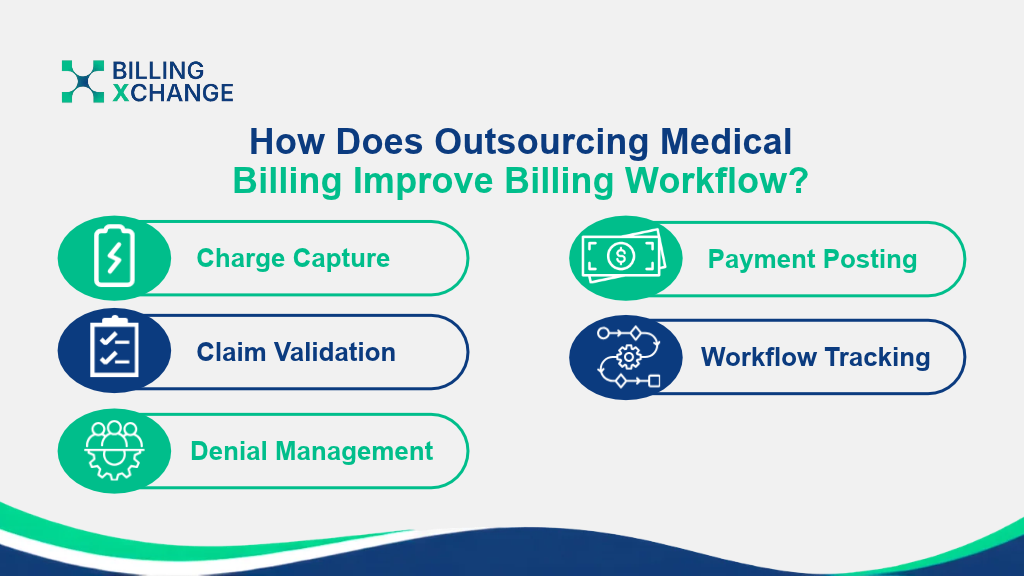
Implementing Outsourcing Medical Billing improves workflow by establishing a defined sequence across every stage of the revenue cycle, ensuring clear task ownership from charge capture to payment posting.
Step 1: Charge Capture
- Coding Review: Verify procedure codes, clinical documentation to ensure claim validation prior to submission.
- Bottleneck Prevention: Identify missing registration, documentation, coding details before claims enter submission queues.
Step 2: Claim Validation
- Structured Processing: Move validated claims promptly through connected submission channels.
- Submission Speed: Monitor stages affecting transmission speed to keep billable encounters moving smoothly.
Step 3: Denial Management
- Correction Queues: Direct rejected claims into immediate correction queues with clear task assignments.
- Documented Resolution: Process denied claims through structured appeals to address root causes instead of single events.
Step 4: Payment Posting
- Adjudication Tracking: Route accepted claims toward payment posting, track financial reconciliation.
- A/R Recovery: Manage outstanding claims by aging bucket to ensure timely resolution.
Step 5: Workflow Tracking
- Metric Monitoring: Track first-pass acceptance rates, rejection causes, time from charge capture to submission.
- System Visibility: Partner with BillingXChange to gain clear visibility into claims approaching filing limits.
A documented workflow gives management a clearer basis for improving staffing, handoffs, and claim controls when partnering with an Outsourcing Medical Billing company.
How Does Outsourcing Medical Billing Handle Rejected Claims?
Implementing Outsourcing Medical Billing resolves rejected claims through a defined correction loop and continuous workflow improvement.
1. Dedicated Rejection Workflows
- Route claims into specialized queues to maintain visibility.
- Identify demographic, coding, or modifier issues quickly.
2. Structured Correction Loop
- Assign ownership for immediate claim correction and resubmission.
- Fix missing data points before claims become aged.
3. Root-Cause Analysis
- Track recurring rejection reasons to correct front-end errors.
- Refine documentation handoffs and templates to prevent repeats.
4. Specialty Alignment
- Apply systematic controls across medical and Dental Billing.
- Align resolution procedures with specialty and payer requirements.
AAPC compliance guidance for third-party billing also stresses safeguards around coding practices, documentation, confidentiality, and claim submission procedures for Outsourced Medical Billing for Healthcare Providers.
Why Is Outsourcing Medical Billing Important for Timely Claim Filing?
Filing deadlines makes time a direct revenue control, making Outsourcing Medical Billing Services essential to protect reimbursement. Practices reviewing controls can use these structured solutions to set clear oversight.
Past deadlines, claims become non-payable, including CMS Medicare claims exceeding 12 months. Internal lead-time targets and aging alerts flag missing documentation, authorization, or corrections early.
Structured reporting categorizes delays by charge capture, coding, eligibility, or rejections. BillingXChange supports practices with structured workflows, clear reporting, and consistent account management.
Conclusion
Outsourcing Medical Billing works best as a structured daily revenue process using clear ownership, deadline tracking, rejection handling, and consistent follow-up. A strong model relies on accurate data through every stage impacting submission and payment.
Evaluating workflows identifies bottlenecks in registration, coding, submission, and rejections. Addressing root causes early resolves operational issues before claims become delayed or aged.
BillingXChange supports practices seeking clear billing accountability and consistent execution through Outsourcing Medical Billing. Contact us today to reduce filing delays and improve overall billing performance.
Frequently Asked Questions
1. Can an outsourced team prevent timely filing denials completely?
A specialized team using Medical Billing Outsourcing significantly reduces delays through deadline tracking, work queues, and dedicated follow-up. However, it cannot guarantee zero denials, as external payer rules and documentation issues still affect payment.
2. How are claims tracked when approaching a filing deadline?
Through Medical Billing Outsourcing, claims nearing limits are identified using aging reports, payer-specific rules, and priority queues to prompt immediate action before deadlines expire.
3. Does an outsourced service include rejected claim correction?
Yes. Effective Medical Billing Outsourcing covers rejection review, correction, resubmission, and root-cause reporting, provided these responsibilities are clearly defined in the service agreement.
4. What should practices measure after implementing this model?
Track submission turnaround, rejection rates, denial causes, clean-claim ratios, A/R aging, and approaching deadlines to ensure Medical Billing Outsourcing continuously reduces workflow delays.
5. Is this model suitable for growing medical groups?
It supports scaling practices when claim volume exceeds internal capacity, provided leaders evaluate specialty expertise, software integration, security, and clear task ownership.

BillingXchange team
Written by the BillingXchange team. We help dental and medical practices reduce denials, accelerate payments, and maximize collections through expert revenue cycle management.