Top 10 Reasons Why Dental Claims Get Rejected and How to Solve Them
On this page
Managing Dental Claims accurately is essential for a healthy dental revenue cycle. Many claims are rejected because of coding errors, missing documentation, incorrect patient information, or insurance eligibility issues. Preventing these errors helps improve reimbursements and maintain steady cash flow.
For dental practices, DSOs, and billing teams, accurate claim submission is essential. Clean billing processes lead to faster reimbursements, fewer denials, and improved operational efficiency while ensuring compliance with payer guidelines.
Many organizations rely on professional Dental Billing services to streamline revenue cycle management and reduce administrative workload. This guide explains the common rejection reasons and practical ways to improve Dental Claims.
What Are Dental Claims?
Dental Claims are reimbursement requests submitted by dental providers to insurance companies after treatment. They include patient information, insurance details, CDT procedure codes, provider credentials, and supporting documentation required for payment review.
Insurance companies review Dental Claims to verify eligibility, coverage, documentation, and policy requirements before processing reimbursement. Missing or inaccurate information can result in claim rejection or payment delays.
Since claim reimbursement directly affects revenue, practices must prioritize accuracy and consistency. Standardized workflows and experienced billing teams help improve first-pass acceptance rates and reduce avoidable rejections.
Top 10 Reasons Why Dental Claims Are Rejected?
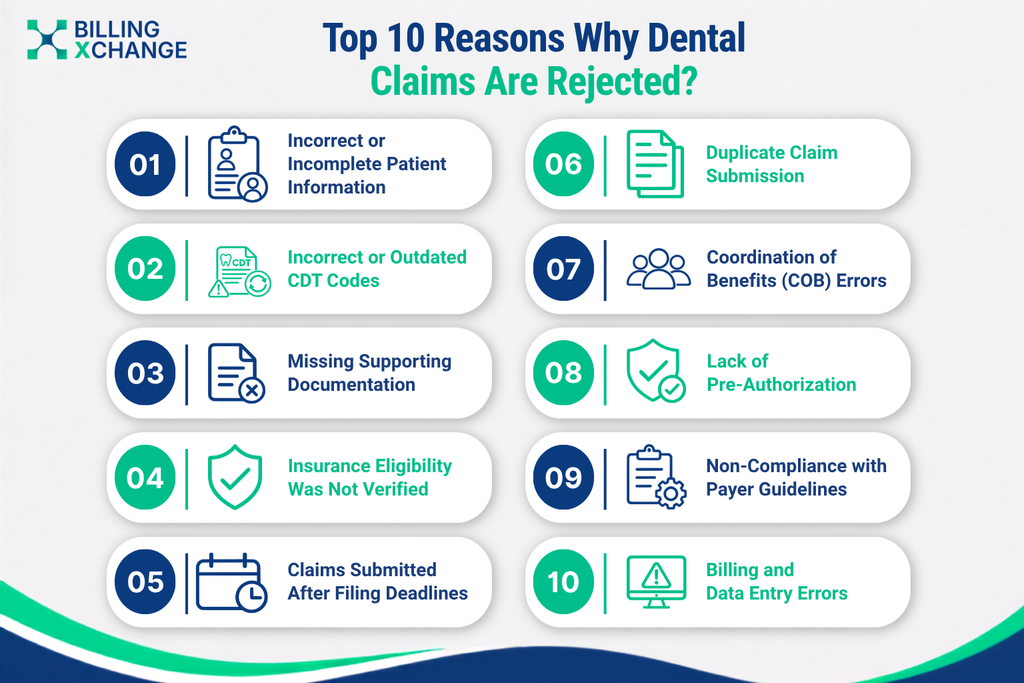
Submitting accurate Dental Claims is essential for maintaining a healthy revenue cycle. Coding errors, missing documentation, insurance issues, and non-compliance with payer requirements are common reasons for claim rejections.
1. Incorrect or Incomplete Patient Information
- Incorrect Patient Details: Errors in the patient’s name, date of birth, or subscriber information can prevent insurers from verifying coverage.
- Invalid Insurance Information: Incorrect policy numbers, subscriber IDs, or group numbers often result in claim rejection.
- Outdated or Unverified Records: Failure to update insurance details before treatment increases the risk of rejected claims.
- Manual Data Entry Errors: Typing mistakes during patient registration frequently lead to claim corrections and resubmissions.
2. Incorrect or Outdated CDT Codes
- Incorrect or Outdated CDT Codes: Using inaccurate or obsolete procedure codes can delay or reject claims.
- Diagnosis and Procedure Mismatch: Inconsistent coding makes it difficult for insurers to validate treatment necessity.
- Lack of Coding Updates and Training: Failure to follow annual CDT revisions and coding guidelines increases billing errors.
3. Missing Supporting Documentation
- Incomplete Clinical Documentation: Missing clinical notes or treatment narratives make claim evaluation difficult.
- Missing Supporting Attachments: Radiographs, intraoral photographs, and periodontal charts are often required for claim approval.
- Insufficient Evidence of Treatment: Claims submitted without proper documentation are commonly rejected or delayed.
4. Insurance Eligibility Was Not Verified
- Inactive or Expired Coverage: Claims submitted for inactive insurance policies are commonly rejected.
- Benefit Changes or Coverage Limitations: Policy updates or non-covered services can affect reimbursement eligibility.
- Failure to Verify Eligibility: Skipping insurance verification before treatment increases claim rejection risks.
5. Claims Submitted After Filing Deadlines
- Missed Filing Deadlines: Every payer has a timely filing limit, and late submissions are usually rejected.
- Delayed Documentation or Administrative Workflows: Incomplete records or workflow delays often postpone claim submission.
- Preventable Revenue Loss: Missing filing deadlines results in delayed or unrecoverable reimbursements. Learn more in Dental Claims Denied.
6. Duplicate Claim Submission
- Duplicate Claim Entries: Resubmitting the same claim or system-generated duplicates commonly trigger automatic rejection.
- Unnecessary Administrative Work: Duplicate submissions increase follow-up efforts and delay payment processing.
- Poor Claim Tracking: Failing to verify claim status before resubmission leads to duplicate claims.
7. Coordination of Benefits (COB) Errors
- Incorrect Insurance Order: Wrong primary or secondary payer information delays claim processing.
- Outdated COB Information: Changes in employment or insurance coverage require updated benefit coordination.
- Improper Benefit Sequencing: Incorrect coordination prevents accurate reimbursement. Additional best practices are covered in Why Dental Claims Get Denied.
8. Lack of Pre-Authorization
- Missing Prior Authorization: Certain procedures require insurance approval before treatment begins.
- Failure to Follow Authorization Requirements: Skipping required approvals significantly increases rejection rates.
- Payer-Specific Authorization Rules: Authorization requirements vary by insurance provider and procedure.
9. Non-Compliance with Payer Guidelines
- Incorrect Claim Submission: Using the wrong claim forms or missing required attachments can result in rejection.
- Incomplete Documentation: Missing information prevents insurers from completing claim reviews.
- Failure to Meet Payer Requirements: Ignoring payer-specific billing and submission rules increases rejection rates. See Dental Claim Denials and Solutions for additional guidance.
10. Billing and Data Entry Errors
- Typing and Data Entry Mistakes: Typographical errors, incorrect provider information, or invalid NPI numbers commonly cause claim rejection.
- Incomplete Claim Information: Missing signatures or mandatory claim fields prevent successful processing.
- Lack of Quality Review: Reviewing claims before submission reduces errors and improves first-pass acceptance rates.
How to Solve Rejected Dental Claims?
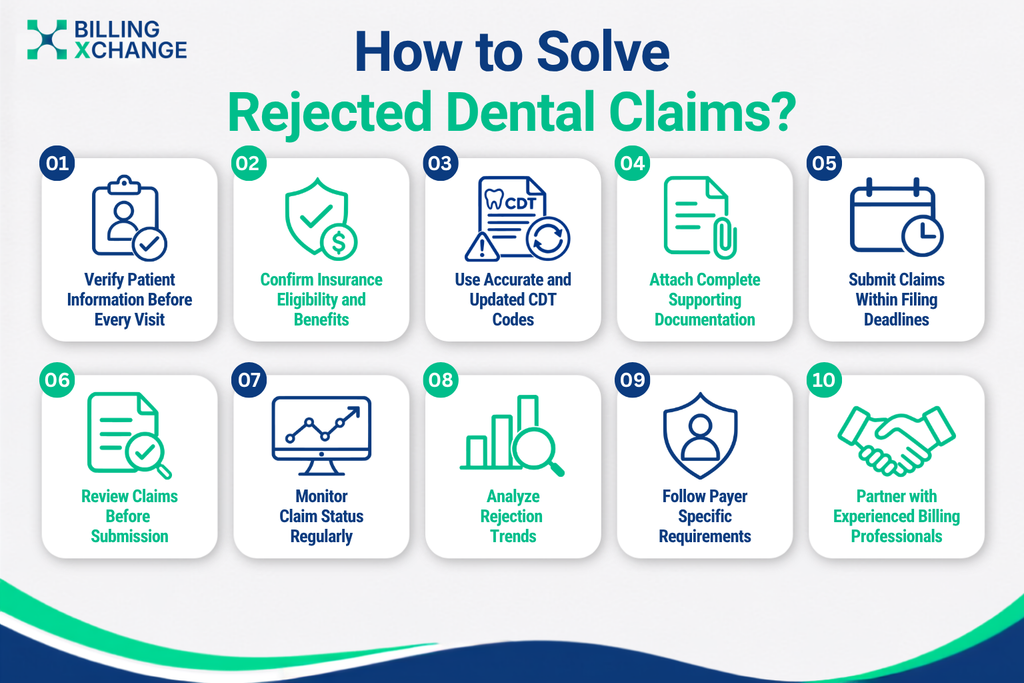
Rejected Dental Claims do not always result in lost revenue. Most rejected claims can be corrected and resubmitted after identifying the root cause. Implementing the right billing practices helps dental providers improve claim acceptance rates, reduce denials, and strengthen their revenue cycle.
1. Verify Patient Information Before Every Visit
- Verify the patient’s name, date of birth, insurance ID, policy number, and subscriber details before treatment.
- Confirm patient information at every appointment to reduce data entry errors.
- Ensure claims are submitted with accurate and updated patient records.
2. Confirm Insurance Eligibility and Benefits
- Verify insurance eligibility before providing treatment.
- Confirm coverage details and treatment benefits before services are performed.
- Prevent claim rejections caused by inactive coverage or non-covered procedures.
3. Use Accurate and Updated CDT Codes
- Submit claims using the latest CDT procedure codes.
- Follow payer-specific coding guidelines and requirements.
- Provide coding education and conduct regular audits to reduce errors.
- Prevent coding mistakes that delay reimbursement.
4. Attach Complete Supporting Documentation
- Include required clinical notes and treatment narratives.
- Attach radiographs, periodontal charts, photographs, and other supporting documents when needed.
- Ensure complete documentation is submitted for faster claim review.
- Reduce additional requests from insurance companies.
5. Submit Claims Within Filing Deadlines
- Track payer filing limits and submission deadlines.
- Submit claims promptly after treatment completion.
- Avoid automatic rejection caused by late claim submissions.
6. Review Claims Before Submission
- Perform a final quality check by following Dental Billing best practices before submitting claims.
- Identify missing fields, incorrect provider information, and policy errors.
- Check for duplicate entries and documentation gaps.
- Improve first-pass acceptance rates.
7. Monitor Claim Status Regularly
- Monitor submitted claims through payer portals or clearinghouses.
- Identify rejected or pending claims early.
- Resolve issues quickly to prevent cash flow delays.
8. Analyze Rejection Trends
- Review rejection reports to identify common denial patterns.
- Identify recurring coding, documentation, and eligibility issues.
- Improve billing processes to reduce future claim rejections.
9. Follow Payer-Specific Requirements
- Stay updated with insurance company requirements and Medical Billing compliance standards.
- Follow payer documentation standards and claim submission rules.
- Ensure claims meet all reimbursement guidelines before submission.
10. Partner with Experienced Billing Professionals
- Work with experienced billing specialists who understand payer requirements.
- Use professional Medical Billing support to improve claim accuracy and compliance.
- Leverage specialized Dental Billing services for eligibility verification, coding accuracy, and timely submissions.
- Reduce rejections, accelerate reimbursements, and maximize collections.
Dental Claims Reason for Rejection and How to Solve
| Reason for Rejection | How to Solve It | Result |
| Incorrect patient information | Verify patient and insurance details before every visit. | Fewer claim errors and faster processing. |
| Incorrect or outdated CDT codes | Use the latest CDT codes and follow payer guidelines. | Improves coding accuracy and reimbursement. |
| Missing supporting documentation | Attach all required clinical notes, X-rays, and narratives. | Reduces documentation-related rejections. |
| Insurance eligibility not verified | Confirm coverage and benefits before treatment. | Prevents eligibility-related claim rejections. |
| Claims submitted after filing deadlines | Submit claims within the payer’s filing deadline. | Avoids automatic claim rejection. |
| Duplicate claim submission | Track claim status before resubmitting. | Prevents duplicate claims and payment delays. |
| Coordination of Benefits (COB) errors | Verify primary and secondary insurance information. | Ensures accurate claim processing. |
| Lack of pre-authorization | Obtain prior authorization for required procedures. | Improves claim approval rates. |
| Non-compliance with payer guidelines | Follow payer-specific billing and documentation requirements. | Increases first-pass claim acceptance. |
| Billing and data entry errors | Review every claim before submission. | Reduces errors and accelerates reimbursement. |
Why Choose BillingXchange for Dental Claims?
Managing Dental Claims requires accuracy, compliance, and timely follow-up. Even small billing errors can cause claim rejections, delayed reimbursements, and revenue loss. BillingXchange provides revenue cycle solutions that help dental practices improve claim acceptance and maximize collections.
Our billing specialists understand payer requirements, CDT coding standards, and claim submission processes. From insurance verification to denial management and accounts receivable follow-up, we ensure efficient and accurate claim handling.
Whether you manage a single practice or a multi-location DSO, BillingXchange streamlines billing workflows with accurate Dental Claims submission, coding support, and reporting solutions, allowing your team to focus on patient care while improving revenue performance.
Conclusion
Submitting accurate Dental Claims is essential for improving cash flow and maintaining a healthy revenue cycle. Most rejections occur due to coding errors, missing documentation, insurance issues, or payer compliance problems. Following best billing practices helps dental organizations improve claim acceptance rates and reduce avoidable denials.
Partnering with BillingXchange helps practices streamline claim management through accurate submissions, compliance-focused billing, and proactive follow-up. Expert support helps accelerate reimbursements, minimize revenue loss, and improve overall revenue cycle efficiency.
Ready to improve your Dental Claims performance? Partner with BillingXchange for accurate claim submission, faster reimbursements, and reduced claim rejections. Contact us today to streamline your revenue cycle and maximize your practice’s financial growth.
Frequently Asked Questions (FAQs)
Processing time depends on the insurance provider, claim accuracy, and required documentation. Most clean claims are processed within a few weeks, while claims with errors or missing information may take longer.
Insurance companies may require clinical notes, treatment narratives, radiographs, periodontal charts, photographs, and other supporting records depending on the procedure and payer requirements.
Practices should verify patient information, confirm insurance eligibility, use accurate CDT codes, attach complete documentation, and review every claim before submission to reduce avoidable rejections.
Most rejected claims can be corrected and resubmitted after resolving the identified issue. Prompt follow-up helps prevent payment delays and protects practice revenue.
Outsourcing to BillingXchange provides access to experienced billing specialists who improve claim accuracy, reduce administrative workload, accelerate reimbursements, and strengthen overall revenue cycle performance.

BillingXchange team
Written by the BillingXchange team. We help dental and medical practices reduce denials, accelerate payments, and maximize collections through expert revenue cycle management.
The Basics of Payment Posting: Definition, Process, and Best Practices
NextAccounts Receivable Recovery for Healthcare and Medical Practices

How Dental Claims Management Impacts the Overall Patient Experience
Sep 18, 2026
Understanding Dental Billing Outsourcing: A Primer for Practice Owners
Sep 17, 2026
How Dental Payment Processing Works: A Step-by-Step Overview
Sep 17, 2026