
What Is the Dental Insurance Claims Process and How Does It Affect Your Bill?
On this page
For dental practices, understanding the Dental Insurance Claims Process helps reduce payment delays, billing errors, and revenue uncertainty.
For dental groups, DSOs, and multi-location practices, efficient claims management ensures accurate coding, timely submissions, and better reimbursement tracking.
This guide explains how the Dental Insurance Claims Process works, affects patient bills, and helps practices improve claims efficiency.
What Is the Dental Insurance Claims Process?
The Dental Insurance Claims Process includes the steps a dental practice follows to request insurance payment after treatment. It starts with collecting patient information, verifying eligibility, documenting treatment, coding procedures, and submitting the claim.
The insurance company reviews the claim and may approve payment, request additional information, partially approve it, or deny it. The practice then posts the payment and determines the remaining patient balance.
According to the Lifecycle of a Dental Insurance Claim Process, effective claim management covers multiple stages from patient information to final reimbursement. For dental organizations, managing each stage efficiently supports a more predictable revenue cycle.
How Does the Dental Insurance Claims Process Work?
The Dental Insurance Claims Process follows several connected stages, from patient registration to payment posting. Each stage helps dental practices improve claim accuracy, reduce delays, and maintain a smoother revenue cycle.
Patient Registration & Insurance Verification
- Accurate Patient Information: Collect complete demographic, insurance, and subscriber details to prevent claim errors.
- Eligibility Verification: Confirm active coverage, benefits, deductibles, limitations, and other plan requirements before treatment.
Treatment & Documentation
- Complete Treatment Records: Maintain treatment notes, diagnostic information, radiographs, photographs, and required supporting documents.
- Strong Documentation: Accurate records give insurance payers the information needed to evaluate and process claims.
Coding & Charge Capture
- Accurate CDT Coding: Assign the correct dental procedure codes and capture all applicable treatment charges.
- Fewer Claim Errors: Correct coding reduces delays, documentation requests, and potential claim denials.
Claim Creation & Submission
- Complete Claim Preparation: Include accurate patient, provider, procedure, treatment date, charge, and required documentation details.
- Timely Submission: Submit claims electronically or through the payer-approved method to support faster processing.
Payer Adjudication
- Claim Review: The insurance payer reviews submitted information against the patient’s policy and coverage rules.
- Payment Determination: The payer calculates the allowed amount, insurance payment, adjustments, and patient responsibility.
Payment Posting & Follow-Up
- Accurate Payment Posting: Record insurance payments, adjustments, and remaining patient balances after claim processing.
- Denial Follow-Up: Investigate denied or underpaid claims, provide additional documentation, correct errors, or submit appeals when necessary.
The Dental Insurance Claim Process services approach shows why consistent coordination across these stages is important for efficient claims management.
How Does the Dental Insurance Claims Process Affect Your Bill?
The Dental Insurance Claims Process can directly affect the amount a patient ultimately pays. The final balance depends on how the insurance plan applies deductibles, coinsurance, coverage limits, and other adjustments.
1: Review Insurance Coverage
- Deductibles: The amount the patient must pay before insurance begins contributing.
- Annual Maximums: The maximum amount the insurance plan may pay during the benefit year.
- Frequency Limitations: Restrictions on how often certain dental procedures are covered.
- Non-Covered Services: Treatments excluded from the patient’s insurance plan.
2: Process the Insurance Claim
- Claim Approval: Insurance pays according to the patient’s eligible benefits.
- Partial Payment: The payer may cover only a portion of the allowed treatment amount.
- Claim Denial: The practice may need to correct, resubmit, or appeal the claim.
- Contractual Adjustments: The provider adjusts charges according to the insurance agreement.
3: Calculate Patient Responsibility
- Coinsurance: The patient pays a percentage of the allowed amount.
- Copayments: A fixed amount may be required for certain covered services.
- Remaining Balance: Any eligible amount not paid by insurance may become the patient’s responsibility.
4: Communicate the Final Bill
- Clear Cost Estimates: Practices can explain expected insurance and patient portions before treatment.
- Accurate Statements: Final bills should reflect insurance payments, adjustments, and remaining balances.
- Better Financial Transparency: Clear communication helps reduce billing confusion and unexpected patient expenses.
How Is a Dental Insurance Claim Submitted?
A Dental Insurance Claims Process requires accurate information and careful review before submission. Following a structured workflow helps dental practices reduce errors, avoid delays, and improve claim processing.
Step 1: Collect Claim Information
- Patient name and date of birth
- Member and group information
- Subscriber details
- Provider identification information
- Procedure codes
- Treatment dates
- Billed charges
Step 2: Verify Claim Details
- Required clinical documentation
- Coordination of benefits information
- Required attachments
- Accurate procedure codes
- Correct patient and insurance information
- Complete provider details
Step 3: Submit the Claim
- Submit claims electronically when available
- Use the payer-approved submission method
- Confirm successful claim transmission
- Retain submission records for tracking
Step 4: Monitor and Follow Up
- Track claim status after submission
- Respond to payer requests for additional information
- Correct and resubmit rejected claims
- Follow up on delayed or unpaid claims
A strong Dental Billing workflow combines accurate claim preparation with consistent follow-up. For high-volume dental organizations, standardized processes can reduce rework and improve overall claims efficiency.
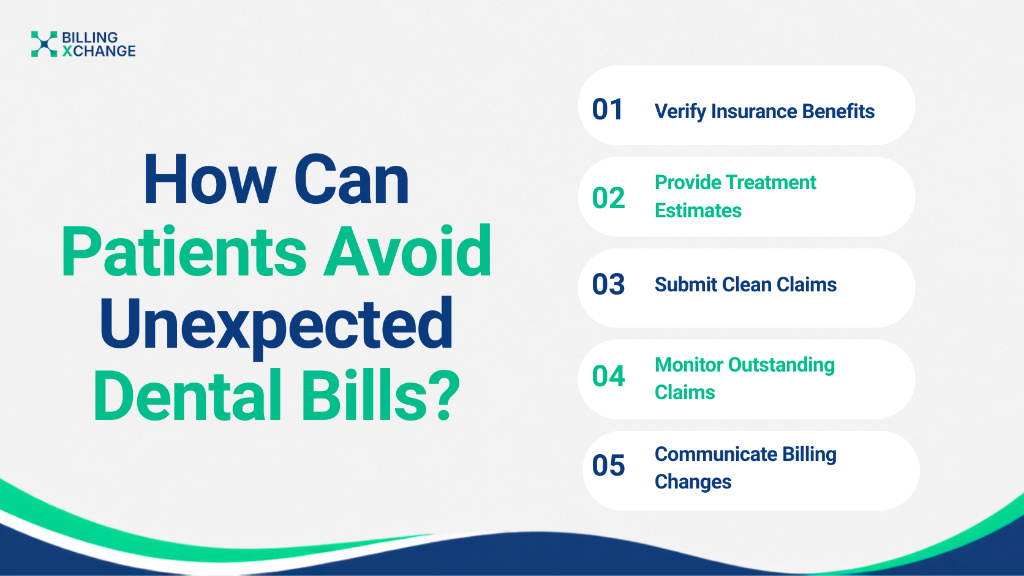
How Can Patients Avoid Unexpected Dental Bills?
Dental practices can help patients avoid unexpected costs by following a clear approach throughout the Dental Insurance Claims Process.
1. Verify Insurance Benefits
- Check active coverage, deductibles, annual maximums, waiting periods, and frequency limitations before treatment.
- Review covered and non-covered services to provide patients with accurate cost expectations.
2. Provide Treatment Estimates
- Give patients an estimate of the expected insurance contribution and potential out-of-pocket costs.
- Explain deductibles, coinsurance, copayments, and other possible charges before treatment.
3. Submit Clean Claims
- Verify patient information, procedure codes, treatment dates, and required documentation before submission.
- Accurate claims can reduce avoidable delays, rejections, and billing changes.
4. Monitor Outstanding Claims
- Track pending, rejected, denied, and unpaid claims regularly.
- Follow up promptly on payer requests and unresolved claim issues.
5. Communicate Billing Changes
- Explain any difference between the original estimate and the payer’s final determination.
- Provide clear statements showing insurance payments, adjustments, and the remaining patient balance.
Dental Insurance Claim and Bill Process
| Step | What Happens | How It Affects the Bill |
| Verify Insurance | The practice checks coverage and benefits. | Shows what insurance may cover. |
| Provide Treatment | Treatment is completed and documented. | Creates the basis for the claim. |
| Submit Claim | Treatment details are sent to the insurer. | Start the payment process. |
| Insurance Review | The insurer reviews and decides the claim. | Determines how much insurance pays. |
| Apply Patient Costs | Deductibles, coinsurance, and non-covered costs are applied. | Determines the patient’s share. |
| Final Bill | Insurance payment is posted and the balance is calculated. | Shows the final amount the patient owes. |
Why Choose BillingXchange for Dental Insurance Claims Process?
For dental organizations, managing high claim volumes, payer requirements, denials, and follow-ups internally can increase administrative workload and delay reimbursements. BillingXchange provides structured claims management workflows to support smoother revenue-cycle operations.
A dedicated approach helps dental practices improve claim preparation, submission, status monitoring, denial follow-up, payment posting, and accounts receivable management. This allows internal teams to focus more on practice operations.
For organizations handling broader healthcare operations, coordinated Medical Billing support can provide greater consistency across revenue-cycle functions. A well-managed Dental Insurance Claims Process can help improve collections, reduce avoidable delays, and create more predictable financial performance.
Conclusion
The Dental Insurance Claims Process directly affects reimbursement speed, administrative efficiency, and patient financial responsibility. An effective process requires accurate verification, documentation, coding, claim submission, follow-up, and payment posting.
A structured approach can reduce errors, improve accounts receivable performance, and create more predictable revenue. BillingXchange helps dental organizations streamline claims workflows, allowing teams to focus on practice operations and patient care.
Improve your Dental Insurance Claims Process and reduce billing delays with expert support. Let help streamline claims, follow-ups, and revenue-cycle operations. Contact us today for BillingXchange to discuss your dental claims management needs.
Frequently Asked Questions (FAQS)
1. What Information Is Needed to Submit a Dental Insurance Claim?
A dental claim typically requires accurate patient and subscriber information, insurance details, provider information, procedure codes, treatment dates, charges, and any required clinical documentation or attachments.
2. What Happens After a Dental Insurance Claim Is Submitted?
After submission, the insurance payer reviews the claim against the patient’s coverage and applicable requirements. The payer may approve the claim, make an adjustment, request additional information, or deny the claim.
3. Why Can a Dental Insurance Claim Be Delayed?
A claim may be delayed because of incorrect patient information, missing documentation, coding errors, incomplete insurance details, coordination-of-benefits issues, or additional information requested by the payer.
4. What Happens When a Dental Insurance Claim Is Denied?
When a claim is denied, the dental practice reviews the denial reason and identifies the required correction or documentation. Depending on the issue, the practice may correct and resubmit the claim or submit an appeal.
5. How Can Dental Practices Improve Claim Processing?
Dental practices can improve claim processing by verifying insurance information, maintaining accurate treatment documentation, using correct procedure codes, submitting complete claims, monitoring claim status, and following up on unpaid or denied claims.

BillingXchange team
Written by the BillingXchange team. We help dental and medical practices reduce denials, accelerate payments, and maximize collections through expert revenue cycle management.
The Impact of Accurate Dental Claim Submission Services on Practice Profits
NextThe Basics of PPO Network Contracting Through Dental Credentialing Services

How Dental Claims Management Impacts the Overall Patient Experience
Sep 18, 2026
Understanding Dental Billing Outsourcing: A Primer for Practice Owners
Sep 17, 2026
How Dental Payment Processing Works: A Step-by-Step Overview
Sep 17, 2026